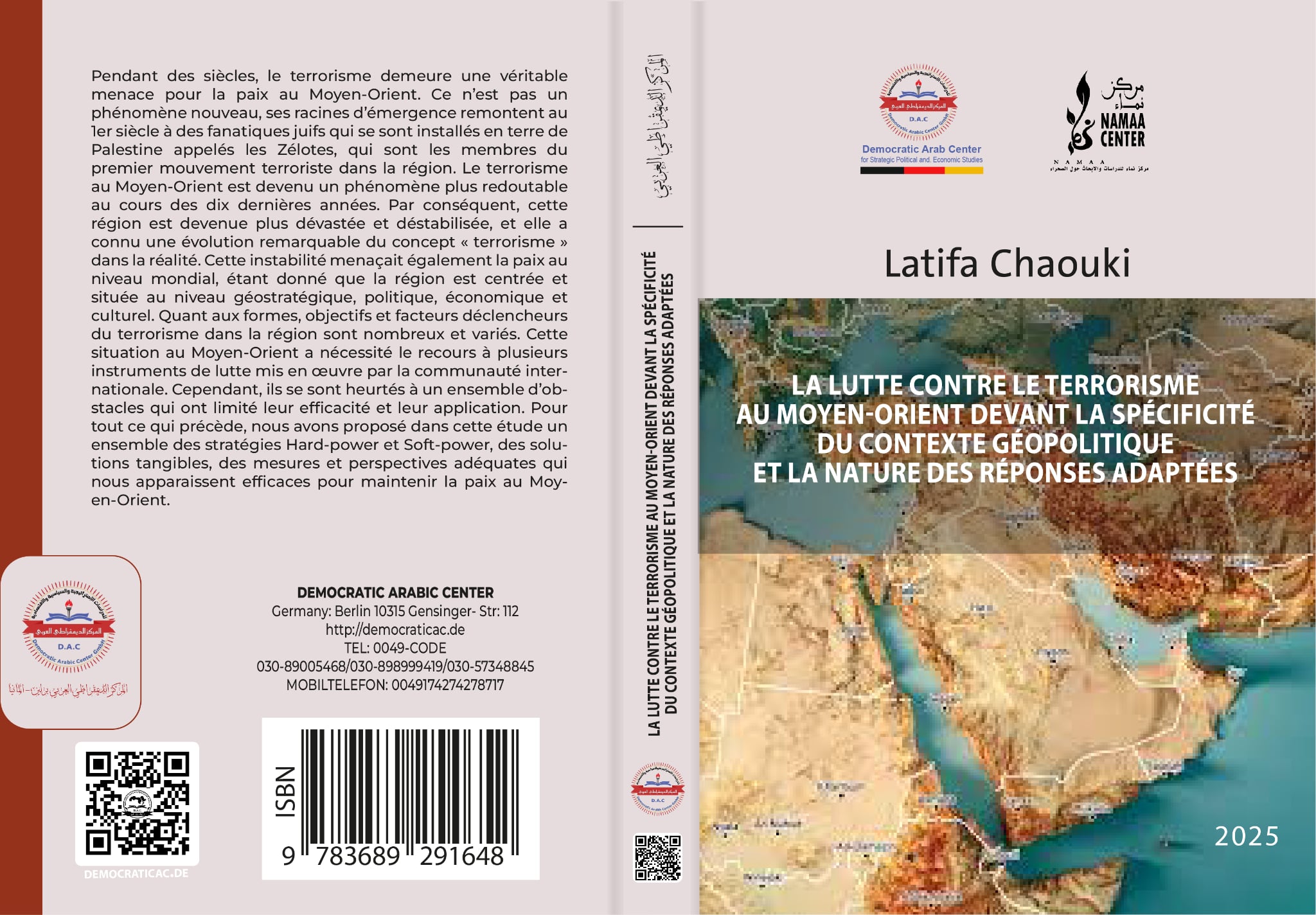
La lutte contre le terrorisme au Moyen-Orient devant la spécificité du contexte géopolitique et la nature des réponses adaptées
The Fight Against Terrorism in the Middle East in Light of the Specificity of the Geopolitical Context and the Nature of Adapted Responses

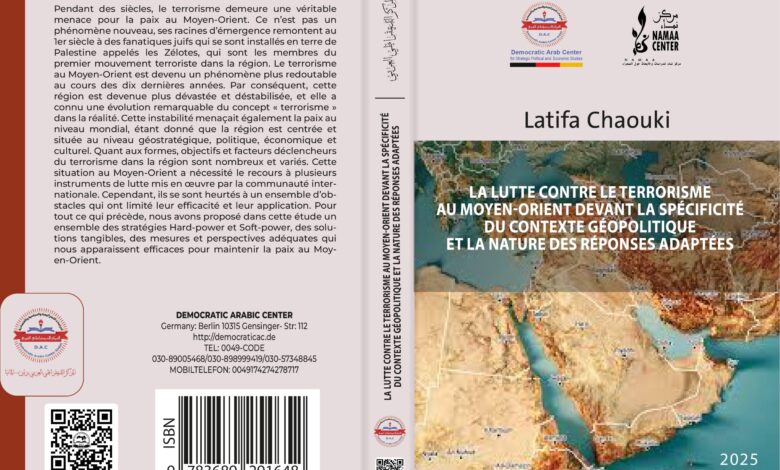
Edited by : Dr. Latifa Chaouki – holds a PhD in International Law and International Politics
Download book version pdf
First edition “2025” – Book : La lutte contre le terrorisme au Moyen-Orient devant la spécificité du contexte géopolitique et la nature des réponses adaptées
All rights reserved to the #Democratic_Arabic_Center Germany – Berlin. Reproduction of this book or any part of it, or storing it in the scope of retrieving or transmitting the information in any form, without the prior Permission in writing of the publishe
Résumé
Pendant des siècles, le terrorisme demeure une véritable menace pour la paix au Moyen-Orient. Ce nest pas un phénomène nouveau, ses racines démergence remontent au 1er siècle à des fanatiques juifs qui se sont installés en terre de Palestine appelés les Zélotes, qui sont les membres du premier mouvement terroriste dans la région. Le terrorisme au Moyen-Orient est devenu un phénomène plus redoutable au cours des dix dernières années. Par conséquent, cette région est devenue plus dévastée et déstabilisée, et elle a connu une évolution remarquable du concept « terrorisme » dans la réalité. Cette instabilité menaçait également la paix au niveau mondial, étant donné que la région est centrée et située au niveau géostratégique, politique, économique et culturel. Quant aux formes, objectifs et facteurs déclencheurs du terrorisme dans la région sont nombreux et variés. Cette situation au Moyen-Orient a nécessité le recours à plusieurs instruments de lutte mis en uvre par la communauté internationale. Cependant, ils se sont heurtés à un ensemble dobstacles qui ont limité leur efficacité et leur application. Pour tout ce qui précède, nous avons proposé dans cette étude un ensemble des stratégies Hard-power et Soft-power, des solutions tangibles, des mesures et perspectives adéquates qui nous apparaissent efficaces pour maintenir la paix au Moyen-Orient.
Abstract
For centuries, terrorism remained a real threat to peace in the Middle East. This is not a new phenomenon, its roots of emergence date back to the 1st century to Jewish fanatics who settled in the land of Palestine called the Zealots, who are members of the first terrorist movement in the region. Terrorism in the Middle East has become a stronger phenomenon in the last ten years. As a result, this region has become more devastated and destabilized, and has experienced a remarkable evolution of the concept terrorism in reality. This instability also threatened global peace, as the region is centered and located at the geostrategic, political, economic and cultural levels. As for the forms, objectives and triggers of terrorism in the region are numerous and varied. This situation in the Middle East has required the use of several instruments of struggle implemented by the international community. However, they faced a set of obstacles that limited their effectiveness and enforcement. For all the above, we have proposed in this study a set of hard-power and soft-power strategies, tangible solutions, adequate measures and perspectives that we consider effective for maintaining peace in the Middle East.
Publisher : Democratic Arabic Center For Strategic, Political & Economic Studies
Democratic Arabic Center- Berlin – Germany